


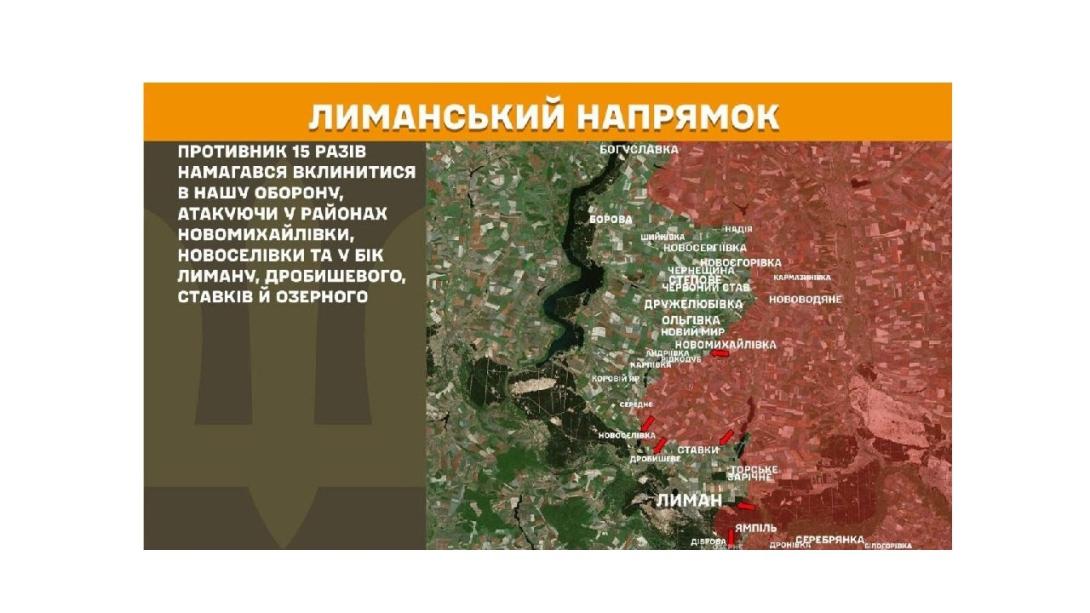
"Enemy troops shelled the territory of Luhansk region 33 times. For attacks, the Russians mainly used mortars, of which 11 attacks were recorded, as well as barrel artillery and easel grenade launchers - two hits each, respectively. The enemy continues to actively use drones: there were 10 explosive drops from UAVs and 8 attacks by FPV drones per day. In addition, in the Lyman direction, Russian troops tried to penetrate Ukrainian defenses 15 times," Oleksiy Kharchenko, head of the Luhansk Regional State Administration, informed.
In Luhansk region, the emergency medical care system is rapidly deteriorating: due to the inaction of the authorities and the shortage of ambulances, local residents, in particular those of retirement age, are left without access to life-saving care. An illustrative incident was when a woman with a severe heart attack could not wait for doctors all day because the dispatch line simply did not respond. While patients are forced to risk their lives and resort to ineffective self-medication in critical conditions, relevant departments completely ignore the problem and do not get in touch, effectively leaving the most vulnerable segments of the population to their fate.
Despite regular statements and promises from the LPR leadership to bring the situation under control, large-scale landscape fires in the region continue to gain momentum and cover new territories every day. Over the past day alone, the fire destroyed more than 124 hectares of land as a result of 24 separate fires. The most critical centers of fire spread were recorded near Perevalsk, where a total of 90 hectares burned, as well as in the city of Rovenky and the Shchastyn district. The occupation authorities only note the daily increase in the scale of destruction, while the real ability of local authorities to stop the disaster remains solely at the level of documentation.