
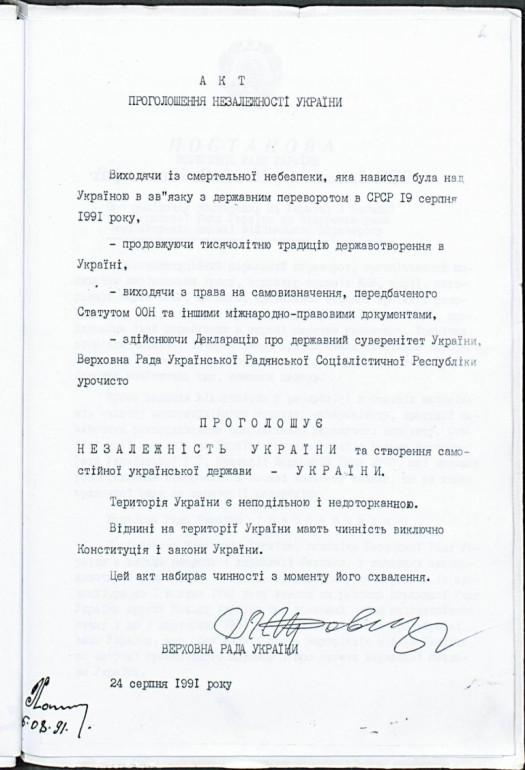
On August 24, Ukraine celebrates its largest national holiday – Independence Day. It is established in honor of an exceptional historical event – the proclamation in 1991 by the Verkhovna Rada of the Ukrainian SSR of the independence of Ukraine and the creation of an independent Ukrainian state. This act crowned the long path of the Ukrainian people to independence. It was based on the Declaration of Sovereignty of July 16, 1990, and was confirmed by the All-Ukrainian referendum of December 1, 1991.
Independence and freedom have always been fundamental values for Ukrainians. They encouraged them to fight and gave them the strength to remain themselves in times of statelessness. The highest expression of freedom for an enslaved people is gaining independence to create their own future.
The declaration of independence on August 24, 1991 was a logical continuation of Ukrainian statehood. Therefore, celebrating the 35th anniversary of the adoption of the Act, we honor all the previous stages of the formation of Ukrainian statehood and emphasize that it was RESTORATION that took place, and not just the declaration of independence. Restoration, because the independence of Ukraine was proclaimed by the Ukrainian Central Rada on January 22, 1918, by the IV Universal. At that time, the state existed for three years in a continuous struggle for preservation. Even then, Ukraine had all the signs of a state: a territory delineated by borders, a coat of arms, an army, a monetary system, a language, and diplomatic relations with other states.
In March 1939, Transcarpathians won and proclaimed the independence of Carpathian Ukraine. The desperate struggle against the Hungarian occupiers was an unprecedented example of resistance to the aggressor on the eve of World War II. The Ukrainians of Transcarpathia were the first in interwar Europe to mobilize to armed resistance to the aggression of the German allies.
In June 1941, in Lviv, defending the principles of statehood, representatives of the OUN proclaimed the Act of Restoration of the Ukrainian State.
Our independence was paid for at a high price – with the large number of lives of those who fought for the idea of a free Ukraine with and without weapons, with the countless years of lost freedom of those who spent their time in camps, prisons, and psychiatric hospitals.
Ukraine's declaration of independence in 1991 played a decisive role in the collapse of the USSR and the final liquidation of the communist totalitarian empire. Now, imperial Russia is once again trying to seize Ukraine, waging a brutal and aggressive war against us, which we call the War for Independence of Ukraine, because it is an existential genocidal war, a war to deny Ukrainian statehood and destroy the national identity of Ukrainians.
The War for Independence of Ukraine from Russia is postponed, since Russia has not stopped political and economic pressure, as well as cultural, historical, and religious influence on Ukraine, starting from 1991. In particular, the Russian Federation has provoked and carried out aggressive actions to create military-political situations that could lead to military action. Let us recall, for example, the territorial disputes around the Russian Black Sea Fleet located in Crimea in the 1990s or the Russian attempts to establish control over the Tuzla Spit near Kerch in 2003. There were also gas and food wars, which de facto aimed at making the Ukrainian economy and trade dependent on Russia.
Today, Ukraine's independence is a guarantee of the free development of the states and peoples of Europe. It is the main obstacle to Russian imperialism, which is trying to politically, economically and spiritually absorb Ukraine and divide Europe into spheres of influence.
A free Ukrainian state, an active and responsible civil society, and a powerful Security and Defense Sector are the foundation that protects human rights and guarantees a decent future for all Ukrainians.
35 years of restoration of independence
How did Ukrainians declare the independence of the UNR in 1918?
World War I (1914–1918) brought about the collapse of four empires (Russian, Austro-Hungarian, German, and Ottoman) and gave rise to the creation of independent nation-states on their ruins. Ukrainians were among the enslaved peoples who rose up to fight for independence.
On March 17, 1917, public and political forces in Kyiv created the Ukrainian Central Rada, which gradually transformed into the parliament of the Ukrainian People's Republic.
On June 23 of the same year, the Central Rada, as the first Universal, proclaimed the autonomy of Ukraine and called for the creation of local Ukrainian authorities, and on June 28, it formed the General Secretariat - the first Ukrainian government.
Events in Moscow and Petrograd – the October Revolution, the overthrow of the Provisional Government, and the formation of the Council of People's Commissars – brought a Bolshevik threat to Ukraine. This prompted the Central Rada to adopt the Third Universal on November 20, 1917, by which it proclaimed the Ukrainian People's Republic.
Meanwhile, the Bolsheviks sought to establish control over Ukraine and viewed the Central Rada as a serious competitor in the struggle.
On December 17, the Council of People's Commissars issued an ultimatum: allow the Bolshevik troops to move from the front to the Don and completely abandon the formation of the Ukrainian Front. The Ukrainians rejected the demands and accused Petrograd of inciting hostilities. The Council of People's Commissars then announced that he considered the Central Rada “in a state of open war against Soviet power in Russia and Ukraine.”
On January 7, 1918, the Bolsheviks announced a general armed offensive against Ukraine. By mid-January, they had established control over almost the entire Left Bank. They were preparing to advance on Kyiv, while simultaneously inciting “workers’ uprisings” (the most violent of which occurred at the Arsenal factory).
The fighting in Kyiv prompted the Central Rada to finally decide on independence. As Mykyta Shapoval said at a meeting of the Ukrainian government on January 8, 1918, “since there is no army, and Ukraine must be defended, the only way out is to declare an independent Ukraine, which will allow it to stand firmly on the international stage and begin organizing a new physical force.”
This took place on January 22, 1918, at a closed meeting of the Small Council (a permanent working body of the Ukrainian Central Executive Committee, which operated between its plenary sessions). Three drafts were submitted for discussion: by Mykhailo Hrushevsky, Volodymyr Vynnychenko, and Mykyta Shapoval, but in the end a joint version was produced.
The proclamation of the IV Universal was preceded by a speech by the chairman of the Ukrainian Central Rada, Mykhailo Hrushevsky: “High Assembly! .. Our people yearn for peace. And the Ukrainian Central Rada has made every effort to grant peace immediately. But the Petrograd government, the Council of People’s Commissars, declares a new “holy war,” and on the other hand, this government is sending its army, the Red Guards, and the Bolsheviks to Ukraine... In order to give our government the opportunity to bring the cause of peace to an end and protect our country from all attacks, the Ukrainian Central Rada decided not to postpone these matters to the Constituent Assembly, and for this purpose the Ukrainian Rada has been holding a permanent, uninterrupted session since January 9 until this time and has decided on an important matter – to issue this Universal.”
The vote for the epoch-making document for Ukraine was taken by roll call. Of the 49 members of the Council, 39 voted “for”, 4 “against”, and 6 abstained. The text of Universal IV is dated January 22, 1918.
The document contained four main provisions: the proclamation of the independence of the Ukrainian People's Republic; the instruction to the Council of People's Ministers to conclude peace with the Central Powers; the declaration of a defensive war with Bolshevik Russia; the declaration of the foundations of internal socio-economic construction and the outline of measures to end the war with the Central Powers.
At the same time, Ukrainians in Galicia – the eastern part of the Austrian crownland – on November 1, 1918, raised an uprising in Lviv (later called the “November Act” or “November Breakthrough”), as a result of which they proclaimed Ukrainian power in the region.
On November 13, the Temporary Basic Law on the State Independence of the Ukrainian Lands of the Former Austro-Hungarian Monarchy was approved, introducing the name of the new state - the Western Ukrainian People's Republic.
On January 22, 1919, on the anniversary of the declaration of independence of the Ukrainian People's Republic, the UNR and the ZUNR united into a single independent state.
Independence of 1939. Carpathian Ukraine
After World War I, the territory of Transcarpathia became part of Czechoslovakia. In October 1938, the autonomy of Carpathian Ukraine was proclaimed with the capital in Uzhhorod, where its own government was established. And on March 15, 1939, Carpathian Ukraine voted for independence at a meeting of the Sojm of Carpathian Ukraine, determining the form of state formation - a republic headed by a president elected by the Sojm.
The state language of Carpathian Ukraine was declared Ukrainian. The national blue-and-yellow flag was approved as the state flag, and the coat of arms was a combination of the regional coat of arms (a red bear and four blue and three yellow stripes) with the national one (the trident of Volodymyr the Great with a cross on the middle prong). The national anthem was declared the national anthem "Ukraine is Not Dead Yet." Augustyn Voloshyn was elected president of the newly created Ukrainian state. He emphasized the desire for independence of the region back in January 1939 in an interview “On the Current Problems of Carpathian Ukraine”: “We want to live our own life, our Ukrainian culture, and, consistently and firmly defending our own, we do not shy away from respecting the spiritual wealth of others. <…> We are building a new Carpathian Ukraine and its main city, which will likely be Khust. We are already negotiating the construction of about a hundred apartments for civil servants. We will build a government palace, a university, a cathedral, student housing, a museum, and a Ukrainian folk theater there. It will be a modern district with wide streets. Next year, in the spring, we will begin building a railway line.”
On the day of the declaration of independence of Carpathian Ukraine (March 15, 1939), with Hitler's tacit consent, Hungary attacked the region. The Carpathian Sich stood up to defend the land from the invaders. However, on March 18, the enemy captured almost all of Carpathian Ukraine. The center of Ukrainian statehood was destroyed, but the Ukrainians in Transcarpathia were the first in interwar Europe to offer armed resistance to Germany's allies.
World War II. From idea to struggle
One of the bloodiest periods in the history of state formation was the period of World War II. When the USSR occupied Western Ukraine in 1939, the Organization of Ukrainian Nationalists first encountered the repressive machine of the USSR – the NKVD. Desperate resistance to the communist regime led to numerous losses: according to various sources, from 16 to 35 thousand were arrested and executed. However, even under harsh conditions, the beginning of World War II provided a chance to realize the main strategic task – to gain their own state.
The Organization of Ukrainian Nationalists, led by Stepan Bandera, seized the opportunity. On June 30, 1941, they held a National Assembly in Lviv, where they proclaimed the Act of Restoration of the Ukrainian State and formed a government – the Ukrainian State Government under Yaroslav Stetsky, and began building the Ukrainian National Revolutionary Army.
The act of restoring the Ukrainian state was not coordinated with Germany - the Nazis began repressions against the OUN. On July 5, 1941, Stepan Bandera was arrested in Krakow. He was imprisoned until the end of 1944.
Despite the persecution, the OUN's marching groups, which went deep into Ukraine, proclaimed the Act of Restoration of the Ukrainian State in the cities, actively built up the Ukrainian state apparatus there. By the end of July, the OUN had established power in 187 districts of Western Ukraine, 26 districts of the Right Bank and opened regional administrations in Ternopil, Lviv, Rivne, Drohobych, Ivano-Frankivsk, Lutsk. Ceremonial marches took place in many cities.
In August–September 1941, the occupiers dispersed Ukrainian local governments and carried out mass arrests of activists. By the end of the year, German special services had imprisoned up to 1,500 Bandera members.
In September of the same year, the OUN leadership at its first conference decided to go underground and begin restoring the organizational network. The arrested Bandera was replaced by Mykola Lebed. The nationalists began to prepare for a violent confrontation with the Wehrmacht. At the end of 1942, the Ukrainian Insurgent Army was formed. It was being built in the face of confrontation with enemies on two fronts: anti-Nazi and anti-Soviet. During 1942–1944, the UPA carried out more than 2,500 anti-German actions, during which about 12,500 Germans and their allies were killed, more than 2,000 were wounded, and almost 2,500 were captured.
UPA units also fought with the Red Partisans, who, under the control of Soviet special services, were supposed to fight not only with the Nazis, but also with Ukrainian nationalists. After the expulsion of the Nazi occupiers from Ukraine, the main enemy of the UPA became the communist government. In total, almost 100 thousand soldiers passed through the ranks of the UPA. The personnel of the Ukrainian Insurgent Army amounted to almost 30 thousand people. The UPA fought for an independent united state in which each nation would live a free life.
In July 1944, the Ukrainian Main Liberation Council (UGLR) was established as the supreme political body for leading the liberation struggle. The underground parliament of warring Ukraine was headed by a former representative of the revolutionary parliament of the Ukrainian People's Republic, Kyrylo Osmak.
The UGVR approved the oath of a UPA soldier, documents that highlighted the political platform of the liberation movement. The basis of this platform was a national-democratic program, a call to fight against the totalitarian regime, for the restoration of national independence and a democratic system. The UGVR also approved the main slogan of the UPA - "Freedom to the peoples! Freedom to the individual!".
In the 1960s-1980s, Ukrainians fought for the Ukrainian state by peaceful methods. The Ukrainian Public Group for the Promotion of the Implementation of the Helsinki Accords – the Ukrainian Helsinki Group defended human rights, raised the problems of the political, economic and spiritual separateness of Ukrainians. It was the first legal human rights organization in the Ukrainian SSR, which played one of the key roles in our national liberation struggle, began a non-violent, legal and legal path in Ukraine's gaining independence. Intellectuals, artists-sixties, defending the free development of the Ukrainian language and culture. Their struggle by information methods continued in the 1980s, contributing to the organizational and ideological formation of the national-democratic movement, the establishment of national self-awareness and belief in the possibility of resistance to the repressive state.
The 1990s. The Beginning of the End of the Soviet Empire and the Path to Recovery
In the context of political reforms in the USSR – the liberalization of public life – in March 1990, elections to the Supreme Soviet of the Ukrainian SSR and local councils were held. The Democratic Bloc achieved significant success in these elections. The forces opposing the communist leadership managed to get their representatives into local councils as well. Thus, following the results of the 1990 elections, Ukraine for the first time received at least a partially democratically elected parliament and local councils. The idea of Ukraine’s independence was loudly voiced within the walls of the legislative body. On July 16, 1990, it was formalized in the first legislative act – the Declaration on State Sovereignty of Ukraine.
The attempt in Moscow on August 19, 1991, to “renew” the USSR in Stalinist traditions became the impetus for the development of a national-democratic movement for independence in most of the republics of the USSR. Ukrainians gathered for mass rallies demanding to leave the USSR.
On August 24, 1991, at an extraordinary meeting, the Verkhovna Rada of the Ukrainian SSR adopted the Act of Proclamation of Independence of Ukraine, noting in it that the thousand-year tradition of statehood in Ukraine, which has the right to self-determination, as provided for by the UN Charter and other international legal documents, continues.
On December 1, 1991, at the All-Ukrainian referendum, Ukrainians confirmed their desire to live in an independent state, making it an irreversible fact of history. 90.32% of voters answered affirmatively to the question in the ballot “Do you confirm the Act of Proclamation of Independence of Ukraine?” In the Crimean ASSR, the idea of Ukrainian independence was supported by 54.19% of voters, in the Donetsk region – 83.90% and in the Luhansk region – 83.86%. The referendum proved that the source of Ukrainian statehood is the will of the people, it became a safeguard against attempts to reanimate the USSR in the form of the Treaty on the Union of Sovereign States.
Today, in the conditions of the War of Independence, we are fighting back with dignity and once again defending our own freedom and independence, as well as peace in Europe. The independence of Ukraine is a beacon of freedom in Europe.
Quotes from Ukrainian historians and politicians about the independence of Ukraine
- “We need to stop talking about a ‘strategic partnership’ [with Russia] and a ‘great neighbor’ and prepare the people for a possible escalation of relations with a state that has directly declared its aggressive intentions.”
Vyacheslav Chornovil. From the book "The Pulse of Ukrainian Independence"
- “I am sure that the West is making a big mistake, believing that by helping Russia it will have a democratic Russia in the future. This is a very dangerous illusion. As long as Russia remains an empire in its structure and mentality, it will never be a democratic country. These are incompatible concepts. Chechnya is an eloquent and bloody illustration of this. No democratic ideas can unite a society when it is imperial in its structure and traditions. There is another dangerous idea in the West. It is believed that it would be nice to have a calm empire No. 2 in the person of Russia, which would restrain the East. But this is also an illusion, because Russia will never be and will not agree to become empire No. 2. Democracy must spread. If Europe did not dare to make a bridgehead for democracy in Ukraine and Belarus, then the forces of the empire, the communist forces, are already making their bridgehead here. Now the West is beginning to understand the fallacy of its restraint towards the Eastern European states. And now the attention paid to this space, in particular to Ukraine, indicates that the attitude towards us is changing. Ukraine’s aspiration for independence has always been an aspiration for Europe, for the civilized world. But we are not for isolating Russia. Only a selective and targeted combination of support and influence can help transform Russian statehood, turning it from a constant threat to neighboring states into their predictable and equal partner.”
Vyacheslav Chornovil. From a speech at the international congress “New Atlantic Initiative” in Prague in 1996
- “Look at the Ukrainian historical period of the 20th century, when Ukraine declared its independence six times (at least). You can ask every nation in Europe how they can comment on this. I think many of them will be surprised. And if I say more, we had republics declared that lasted a day and a half, and some lasted three days, such as the state led by Stepan Bandera, which was declared by Yaroslav Stetsko. And during these three days, all the organizers were sent to a concentration camp. For what? Exclusively for the Ukrainian national idea, because he declared the Ukrainian Independent State, which Hitler did not like. And that later insurgent formation, which appeared at the end of 1942, fought equally with both the Nazis and Stalin. My task was to achieve the Ukrainian nation in those sensitive points where without true history it would never be possible to achieve sovereignty. That is, if there is no national language policy, then there is no understanding that sovereignty begins with the language. This is not a policy against Russia, this is a policy for Ukraine. We have already mentioned Bandera. And why shouldn't we talk about Pavlo Skoropadsky? Or about Augustyn Voloshyn? Or about the Western Ukrainian state? Why shouldn't we talk about many, many other projects that show that Ukrainians have never slept peacefully. That is, we grabbed every opportunity to return what elevates the nation, but does not set itself the goal of enmity with the Russians, for example. Ukrainian philosophy is really complex, not easy to implement, but sooner or later the topic of Russians will appear. It is not easy to narrate national policy, but it does not contain evil and artificial confrontation. We live in a world where, after the implementation of critical biological needs, the first thought is to have a grouped nation and an effective, integral national state. "That's the kind of policy I wanted to pursue, and when I raised the topics of Ukrainian heroes and the Holodomor, the question was about our truth."
Viktor Yushchenko. From an interview with Ukraїner
“If you open history textbooks, you can read the conceptual phrase – “Ukraine declared independence from the USSR”. But my research has shown that although formally it was independence from the Union, in reality it was independence from Russia. Ukrainian elites declared it just at the moment when the coup took place and Yeltsin was actively seizing power. Even then, in 1991, the issue of Crimea and Donbas began to be raised. Especially loudly – at the end of August. Pavlo Voshchanov, Yeltsin’s official spokesman, made a statement that if Ukraine declared independence, Russia would have the right to review the border conditions. It was about Crimea and Donbas. There are documents that indicate that in October-November 1991, one of Gorbachev’s key advisors, Grigory Shakhnazarov, suggested that Gorbachev start a campaign to prevent the inclusion of Crimea into an independent Ukraine. This topic remained relevant until the beginning of the Ukrainian referendum. The majority observers were shocked that 57% of Crimeans voted for Ukraine's independence. And that 84% voted in Donbass. When Kravchuk told Yeltsin about the results of the referendum in Belovezhskaya Pushcha, he, surprised, asked: "How, and Crimea too?! And Donbass too?!" These territories then became part of Ukraine, but questions about this remained on the agenda of the Russian elite. As did the idea that there could be no complete independence of the republics. So since December 1991, there have been two models of post-Soviet existence: one is independence, which Ukraine advocated and continues to advocate. The other is a model of limited sovereignty, which is associated with the idea of a confederation and Russian control over the post-Soviet space. And the conflict that arose in the fall of 1991, after the coup in Moscow, is still unresolved."
Serhiy Plokhiy. From an interview with the publication "Local History"
Opposition MP Ivan Zayts was caught on vacation in Volyn by the embarrassing news [about the putsch in Moscow on August 19, 1991]. And unlike most people, he knew what to do: “I was visiting my university friend Mykola Lysun in the village… We turned on the TV. They were just announcing all those resolutions of the State Committee for Emergency Situations. And it was clear that this was a coup. I had no choice but to go to Kyiv immediately. Mykola says to me: “Maybe you won’t go? Maybe we’ll stay here? Because we don’t know how events will develop. Maybe we’ll have to dig some more hiding places!” “No, I say, Mykola, the question here is very simple. This is a gang. And the gang loses, Yeltsin wins against them. Finally, I say, they came together! Because it’s always been like that both the Reds and the Whites fought against Ukraine. And now the Reds and the Whites have joined forces. And this is the moment when we must vote for the independence of Ukraine! That's why I'm going to Kyiv so that Ukraine becomes an independent state"...
From the book by Oleksandr Zinchenko “How Ukrainians Destroyed the Evil Empire”
The materials were prepared by Institute employees Hanna Baykenich and Olena Okhrimchuk.